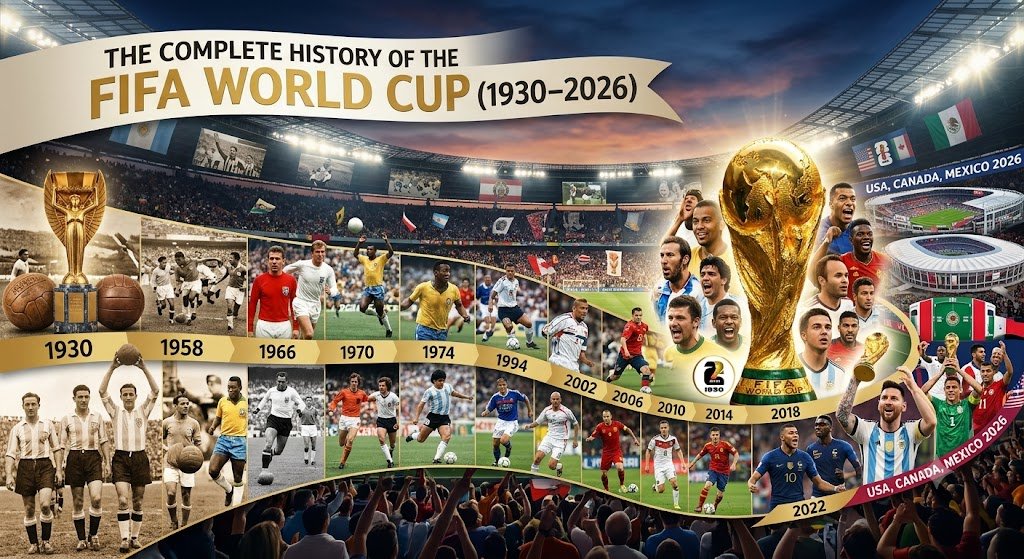
The FIFA World Cup is the most prestigious football tournament in the world, bringing together the best national teams from across the globe every four years. Since its inception in 1930, the tournament has produced unforgettable moments, legendary players, and some of the greatest sporting stories ever told.
The Birth of the World Cup (1930)
The first FIFA World Cup was held in Uruguay in 1930. Thirteen teams participated, with Uruguay defeating Argentina 4-2 in the final to become the first-ever world champions.
At the time, international football was still developing, and many European nations chose not to participate due to the long journey across the Atlantic.
The Early Years (1934–1950)
Italy hosted and won the 1934 World Cup before successfully defending their title in 1938. The tournament was then suspended due to World War II, with no competitions held in 1942 or 1946.
When the World Cup returned in 1950, Brazil hosted the event. In one of football’s greatest upsets, Uruguay defeated Brazil in the decisive match at the Maracanã Stadium, a result famously known as the “Maracanazo.”
The Rise of Football Legends
The World Cup became a global phenomenon during the 1950s and 1960s.
Pelé’s Emergence
In 1958, a 17-year-old Pelé dazzled the world as Brazil won its first World Cup. He helped Brazil secure additional titles in 1962 and 1970, cementing his status as one of football’s greatest players.
England’s Historic Triumph
England claimed its only World Cup title in 1966, defeating West Germany 4-2 after extra time at Wembley Stadium.
The Golden Era (1970–1998)
This period saw the rise of many football icons:
- Johan Cruyff and the Netherlands’ “Total Football”
- Diego Maradona’s brilliance in 1986
- Germany’s consistency on the world stage
- Brazil’s attacking dominance
The 1986 tournament in Mexico remains one of the most famous in history, largely due to Maradona’s performances, including the “Hand of God” goal and the “Goal of the Century” against England.
Expansion and Global Growth
The tournament expanded from 24 teams to 32 teams in 1998, allowing more nations to participate.
This growth helped countries from Africa, Asia, and North America gain greater representation and increased the tournament’s global appeal.
Modern World Cups
2002 – Brazil’s Fifth Title
Brazil won its record fifth World Cup in South Korea and Japan, led by Ronaldo, Rivaldo, and Ronaldinho.
2010 – Africa Hosts the World Cup
South Africa became the first African nation to host the tournament. Spain lifted the trophy after defeating the Netherlands in the final.
2014 – Germany’s Dominance
Germany captured the title in Brazil and delivered a stunning 7-1 victory over the host nation in the semi-finals.
2018 – France Returns to Glory
France won its second World Cup in Russia, with a young Kylian Mbappé emerging as one of football’s brightest stars.
2022 – Argentina and Messi’s Dream
Argentina won the World Cup in Qatar after a dramatic final against France. Lionel Messi finally secured the one major trophy that had eluded him throughout his legendary career.
FIFA World Cup 2026: A New Chapter
The 2026 FIFA World Cup will be the largest in history.
Hosted jointly by the United States, Canada, and Mexico, the tournament will feature 48 teams for the first time.
The expanded format is expected to bring more excitement, more matches, and greater opportunities for emerging football nations to compete on the world’s biggest stage.
Most Successful Nations in FIFA World Cup History
- Brazil – 5 titles
- Germany – 4 titles
- Italy – 4 titles
- Argentina – 3 titles
- France – 2 titles
- Uruguay – 2 titles
- England – 1 title
- Spain – 1 title
Conclusion
For nearly a century, the FIFA World Cup has united billions of football fans around the world. From Pelé and Maradona to Messi and Mbappé, the tournament has created memories that transcend generations.
As the world looks ahead to the 2026 FIFA World Cup, football’s greatest competition continues to inspire dreams, celebrate excellence, and showcase the beautiful game at its very best.
About The Author


