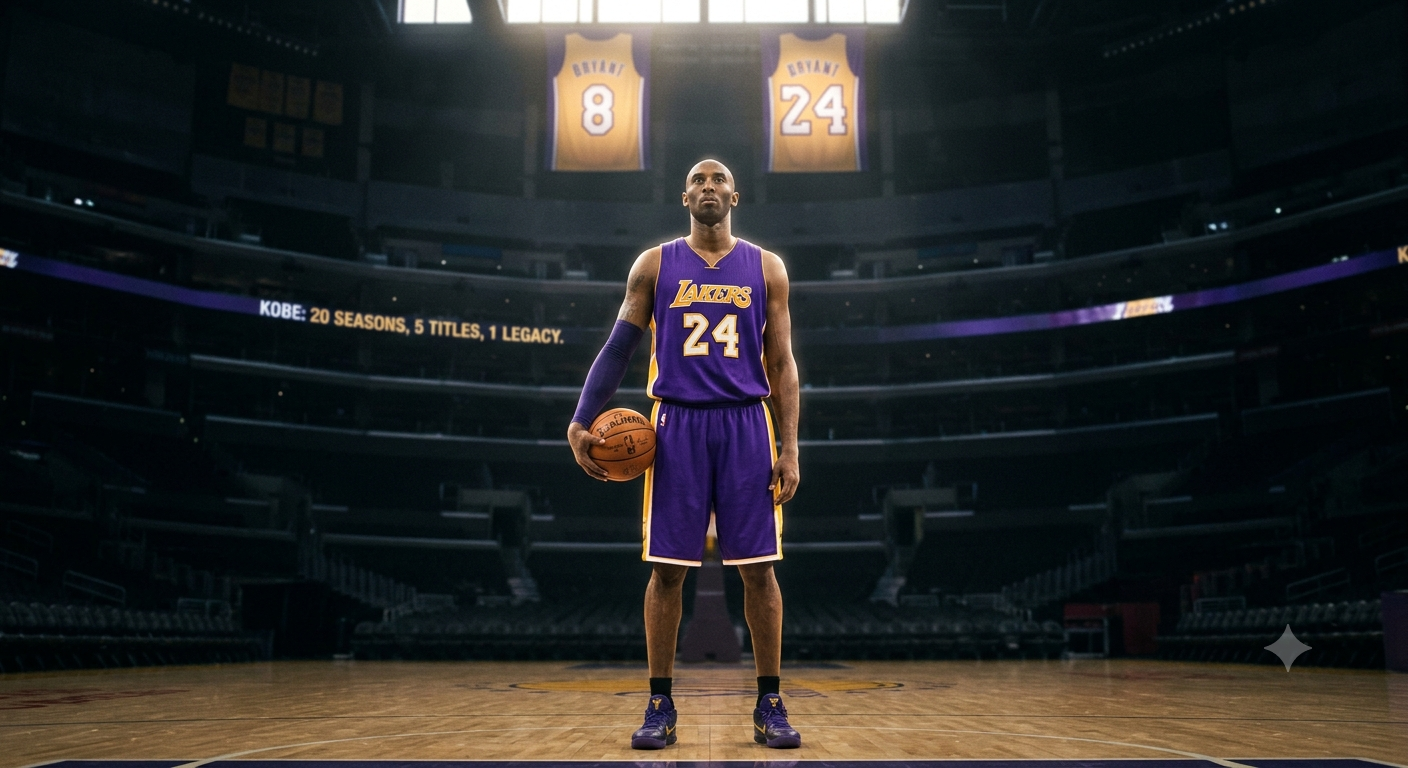
There are athletes who dominate their sport, and then there are those who transcend it, becoming cultural icons whose influence is felt far beyond the arena’s walls. Kobe Bean Bryant was the latter. For twenty years, dressed exclusively in the purple and gold of the Los Angeles Lakers, Bryant didn’t just play basketball; he authored an epic poem of resilience, skill, and unparalleled competitive drive.
His tragic passing in 2020 left a void in the sports world that may never be filled, but his legacy is indestructible. It is woven into the fabric of the NBA, etched into the record books, and alive in the hearts of millions of fans who saw in him not just a basketball player, but the embodiment of a philosophy: the Mamba Mentality. This is the story of that journey—from a teenage phenom in Philadelphia to a global symbol of excellence.
Part I: The Making of a Legend – Early Career and Italian Roots
Kobe Bryant’s origin story was unique among his peers. Born in Philadelphia, Pennsylvania, in 1978, he was the son of former NBA player Joe “Jellybean” Bryant. When Kobe was six, his father moved the family to Italy to continue his professional career. It was here, on Italian courts, that the foundation of Kobe’s game was laid.
While American contemporaries were honing their skills in AAU tournaments, Kobe was learning the fundamentals of spatial awareness, footwork, and tactical strategy in Europe. He immersed himself in the game, often watching tapes of NBA stars sent by his grandfather. This international upbringing gave him a different perspective on basketball, one that valued precision as much as power.
When the family returned to the Philadelphia suburbs, Kobe attended Lower Merion High School. It was here that the phenom emerged. He didn’t just excel; he dominated. By his senior year, he had led Lower Merion to its first state championship in 53 years. His high school performance was so spectacular that he made a revolutionary decision: he was bypassing college and taking his talents directly to the NBA.
Part II: The Purple and Gold Debut and the Creation of “8”
The 1996 NBA Draft was historic, and Kobe Bryant was at its center. Though the Charlotte Hornets selected him with the 13th overall pick, a pre-arranged trade sent him to the Los Angeles Lakers in exchange for center Vlade Divac. It was a masterstroke by legendary Lakers executive Jerry West, who saw the spark of greatness in the 17-year-old.
Rookie Kobe was a sensation, but also a raw work in progress. Dressed in jersey number 8, he was a thrilling athlete, winning the 1997 Slam Dunk Contest. Yet, he also experienced public setbacks, such as airballing multiple potential game-winners in a crucial playoff game against the Utah Jazz as a rookie. Those moments did not break him; they fueled him. They became the first documented examples of the resilience that would define him.
The Dynasty Begins: Kobe and Shaq
By his third season, Kobe had become an All-Star. The arrival of championship-winning head coach Phil Jackson in 1999 unlocked the team’s immense potential. What followed was a standard-setting dynasty. Alongside the most dominant center of the era, Shaquille O’Neal, Kobe (who was maturing rapidly) formed one of the greatest one-two punches in sports history.
From 2000 to 2002, the Lakers accomplished the rare ‘three-peat’, winning three consecutive NBA championships. During this run, Kobe evolved from a talented young scorer to a defensive stopper and a clutch performer. The synergy and friction between Kobe and Shaq became the dominant narrative of the early 2000s NBA, but on the court, they were untouchable.
Part III: Adversity, Evolution, and “24”
The three-peat era ended with a Finals loss in 2004, followed by the departure of Shaquille O’Neal. Kobe Bryant was now the undisputed leader of the Lakers, but it was a lonely throne. This period, from 2004 to 2007, was the most challenging of his professional and personal life.
Amidst significant off-court legal challenges that threatened his freedom and reputation, Kobe turned to the court as his sanctuary. During this isolating time, he developed a alter-ego to compartmentalize his struggles: The Black Mamba. This persona separated his personal life from the cold, clinical competitor on the court. It was a psychological tool that birth the Mamba Mentality.
The Peak of Indomitable Scoring
This era showcased Kobe as an unparalleled offensive machine. Without elite teammates, he carried the Lakers single-handedly. This burden resulted in some of the most statistically astonishing performances ever seen:
- The 81-Point Game: On January 22, 2006, against the Toronto Raptors, Kobe scoring 81 points. It remains the second-highest single-game scoring performance in NBA history, trailing only Wilt Chamberlain’s 100-point game. It is arguably the most famous modern scoring feat.
- 62 in Three Quarters: A month prior, he scored 62 points in just three quarters against the Dallas Mavericks, outscoring the entire opposing team himself before sitting out the final frame.
- Four Straight 50-Point Games: In 2007, he embarked on a scoring binge that saw him record 50 or more points in four consecutive contests, an accomplishment matched only by Wilt Chamberlain.
In 2006, he shifted his identity permanently, switching his jersey from number 8 to number 24. This change symbolized a new chapter—a more mature, focused leader determined to prove he could win without Shaq.
Part IV: Redemption and the Rise of the Mamba
The turning point for the “24” era arrived in early 2008 with the acquisition of Spanish center Pau Gasol. Gasol was the skilled, cerebral partner Kobe desperately needed.
The narrative immediately shifted. Though the Lakers lost the 2008 Finals to their rival Boston Celtics, Kobe was recognized for his phenomenal season by being named the NBA Most Valuable Player (MVP). It was a validation of his individual dominance.
Proving it Alone (Twice)
Fueled by the bitter taste of the 2008 loss, Kobe unlocked another level of focus. The Lakers returned to the Finals in 2009, dismissing the Dwight Howard-led Orlando Magic. Kobe was transcendent, earning his first Finals MVP award and proving his championship mettle as the clear team leader.
The ultimate redemption came one year later in 2010. In a grueling, physical seven-game rematch against the Celtics, the Lakers emerged victorious. Game 7 was not a scoring masterpiece (Kobe shot poorly, a fact he openly admitted), but his legendary willpower in rebounding (15 boards) and leadership sealed the title. Winning his fifth championship, and second consecutive Finals MVP, cemented his legacy among the game’s immortal winners.
Part V: Iconic Records and the Final Bow
As Kobe entered the final phase of his career, age and injuries began to take their toll. He suffered a devastating Achilles tendon tear in 2013, yet in classic Mamba fashion, he walked back onto the court on one leg, sank two free throws, and walked off under his own power. He fought through fractures and tears, determined to finish his 20th season.
His final season, 2015-2016, became a global farewell tour. Arenas that had booed him for two decades erupted in “KO-BE!” chants. His final game, on April 13, 2016, against the Utah Jazz, is widely considered the greatest retirement performance in sports history. Aged 37, on tired legs, Kobe Bryant scored 60 points and engineered a comeback victory, punctuated by a vintage, go-ahead jumper in the final minute. His final words to the crowd, “Mamba Out,” were an iconic conclusion.
A Career of Stunning Records
Kobe Bryant’s statistical footprint is massive:
- 5x NBA Champion (2000, 2001, 2002, 2009, 2010)
- 2x NBA Finals MVP (2009, 2010)
- 2008 NBA MVP
- 18x NBA All-Star (Consecutive selections, a record)
- 4x All-Star Game MVP (A tied-record)
- 11x All-NBA First Team (Tied for the most in history)
- 9x NBA All-Defensive First Team (Tied for the most in history)
- 33,643 Career Points (Currently 4th on the all-time scoring list)
- 1st Player with 30,000+ points and 6,000+ assists.
Clubs and Professional Summary
- Lower Merion High School (1992–1996)
- Los Angeles Lakers (1996–2016, 20 seasons, one of only a few stars to spend their entire career with one team).
Part VI: Mamba Mentality and Global Influence
While the statistics are undeniable, Kobe Bryant’s most profound legacy is the philosophy he championed: The Mamba Mentality. Kobe defined it not as a desire to be better than others, but as “a constant quest to be better than you were yesterday.”
It was about attention to detail, obsessive work ethic (his famous 4:00 AM workouts), resilience in failure, and a ruthless competitive focus. This mentality resonated with countless individuals outside of basketball—surgeons, artists, entrepreneurs, and students. After his passing, “Mamba Mentality” was referenced in award speeches and business boardrooms, highlighting its universal application.
His influence was global, particularly in China, where he was revered with an almost deity-like status. He championed the growth of women’s basketball, notably as a passionate supporter of the WNBA and the “Gigi” line of shoes in honor of his daughter. His retirement also revealed a surprisingly creative second act: winning an Academy Award (Oscar) in 2018 for “Best Animated Short Film” for “Dear Basketball,” a poem he wrote announcing his retirement.
Conclusion: A Legacy That Will Not Fade
Kobe Bryant was not just a basketball player. He was an archetype of dedication, a flawed human who strived for perfection, and a competitor whose will to win altered the gravity of the sport. He was an artist of the hardwood, leaving behind countless moments of grace, power, and clutch performance that are rewatched daily.
The impact he made, the standards he set, and the “Mamba Mentality” he popularized continue to inspire generations. Kobe Bryant gave everything he had to the game of basketball. In return, the game, the city of Los Angeles, and the sports world gave him immortality. The Black Mamba’s legacy will forever be etched in purple and gold.
About The Author


