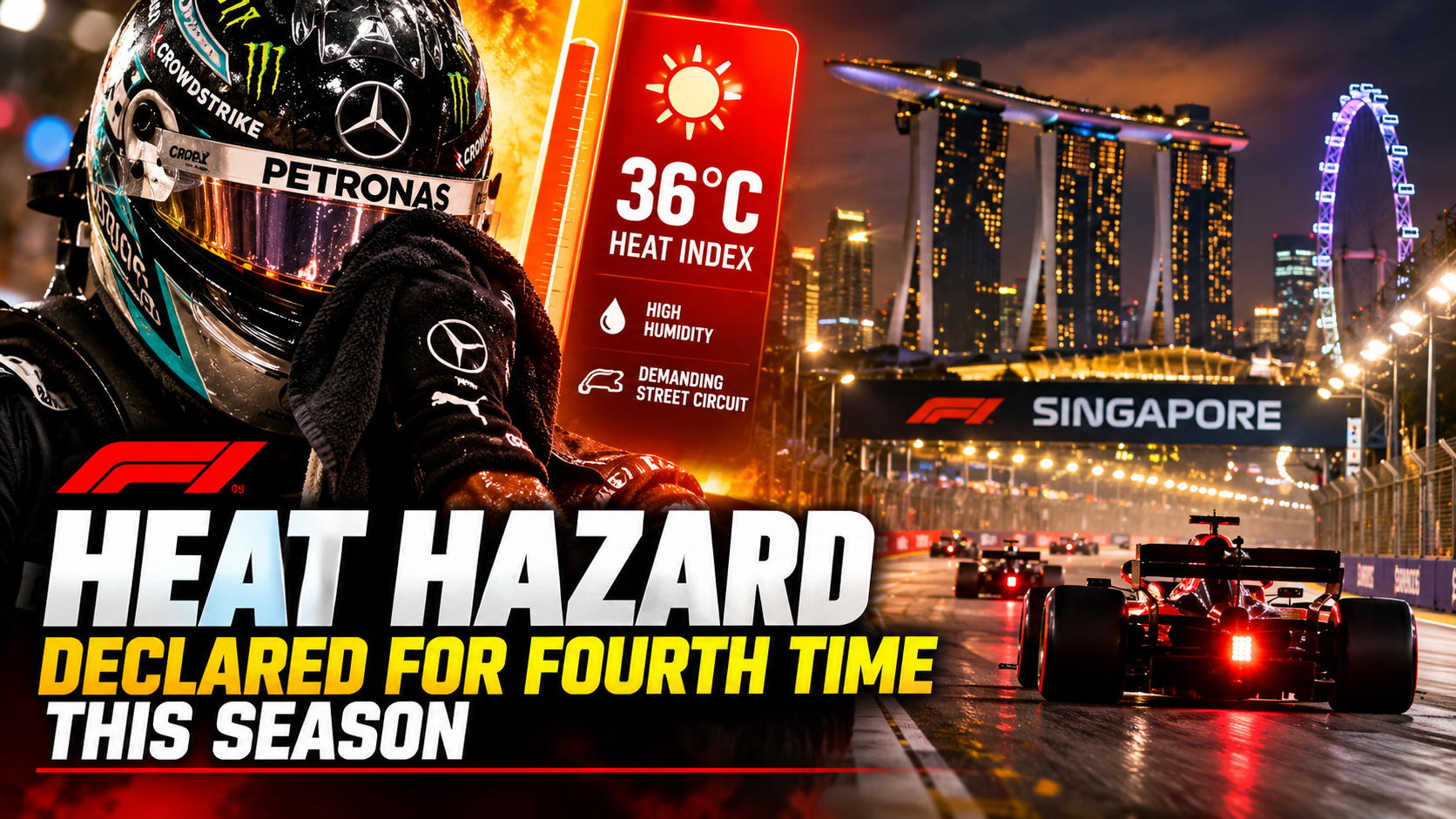
Formula 1 has activated its Heat Hazard procedures for the Singapore Grand Prix weekend, making it the fourth event this season to receive the designation and the second consecutive race weekend to do so.
The FIA formally declared the Heat Hazard on Thursday, October 8, after its official weather service forecast that the heat index would exceed the 31°C threshold during either the Sprint or the Grand Prix at Marina Bay. The declaration applies to both races, meaning teams must prepare the FIA-approved driver-cooling measures for the weekend.
Singapore becomes the latest addition to a growing list of races where extreme heat has become an official consideration for Formula 1.
Austria and Italy triggered the protocol earlier in the season, before the designation was used at the relocated Bahrain Grand Prix at Sepang last weekend. Singapore’s declaration therefore arrives immediately after another heat-hazard event, creating the first back-to-back use of the procedure this season.
And the timing could hardly be more demanding.
Singapore Already Pushes Drivers to the Limit
The Marina Bay Street Circuit is one of the most physically demanding venues on the Formula 1 calendar.
The 4.927-kilometre circuit features 19 corners, with drivers required to maintain concentration and physical effort around a tight, bumpy street track. The race itself covers 62 laps and more than 305 kilometres.
The tropical climate adds another layer.
Formula 1’s latest forecast expects temperatures to reach around 32-33°C, while Saturday’s forecast carries a heat index of approximately 36-38°C. Track temperatures could also climb to roughly 55°C during the hotter parts of the weekend.
That combination of heat and humidity is particularly punishing because drivers cannot simply step away from the conditions once they climb into the cockpit.
For the duration of a session or race, they are effectively sealed inside a high-temperature environment while dealing with intense physical loads, heavy braking and constant concentration.
What Is a Heat Hazard in Formula 1?
The FIA’s Heat Hazard system was developed following the extreme conditions experienced at the 2023 Qatar Grand Prix, where several drivers struggled with the effects of heat and humidity.
Ahead of the 2025 season, the FIA established a procedure allowing a Heat Hazard to be declared when weather forecasts indicate temperatures of 31°C or above at some point during a Sprint or Grand Prix.
Once the designation is activated, teams must prepare the FIA-approved Driver Cooling System.
The system is designed to help reduce the physical effects of extreme cockpit temperatures. It incorporates a pump, plumbing, thermal storage and a fireproof vest through which cooling fluid can circulate.
The objective is straightforward: give drivers an additional way to control their body temperature when environmental conditions become particularly severe.
However, the cooling equipment itself introduces a technical and competitive consideration because of its weight and integration into the car.
The Cooling System Has Become a Story of Its Own
The Singapore declaration comes at a particularly interesting moment for the cooling-system debate.
Mercedes driver George Russell, who suffered from heat exhaustion after the 2024 Singapore Grand Prix, recently questioned the situation surrounding the cooling vest after revealing that he was not using one during the Malaysian weekend.
Russell’s comments have highlighted a wider issue inside the paddock: whether driver cooling should remain an optional solution or become a more universal requirement when a Heat Hazard is declared.
The FIA’s system already attempts to account for the performance implications. Teams that do not use the cooling equipment must compensate with an alternative weight provision, preventing a team from simply removing the equipment to gain a competitive advantage.
That debate is unlikely to disappear while extreme-weather declarations continue to become more frequent.
Four Heat-Hazard Races in One Season
Singapore’s declaration is significant because of how quickly the list has grown.
The first Heat Hazard of the 2026 season was declared for the Austrian Grand Prix in June. The same procedure was activated for the Italian Grand Prix at Monza in September.
Then came the Bahrain Grand Prix at Sepang, where the FIA again predicted conditions above the relevant threshold.
Singapore now becomes the fourth race of 2026 to trigger the protocol.
The repeated declarations do not mean that four races have necessarily experienced identical conditions. The procedure is forecast-based and exists to make sure teams are prepared for potentially hazardous heat before the event takes place.
But the frequency is still notable.
Formula 1 is increasingly having to treat heat management as part of its normal race preparation rather than as an exceptional circumstance.
Singapore’s First Sprint Makes the Weekend Even Tougher
There is another reason this weekend stands out.
The 2026 Singapore Grand Prix is hosting a Sprint for the first time.
That means drivers will have an additional competitive session to manage before Sunday’s main event. The schedule features Free Practice 1 and Sprint Qualifying on Friday, followed by the Sprint and Grand Prix Qualifying on Saturday, before the Grand Prix on Sunday.
The Sprint itself is covered by the Heat Hazard declaration.
That means the FIA’s precautions aren’t limited to the traditional Sunday race. Teams must be prepared for the possibility of severe heat conditions during Saturday’s shorter but still highly competitive contest as well.
For drivers, that creates another layer of physical management.
Drivers Could Lose Several Kilograms During the Race
The physical demands of Singapore are not theoretical.
Formula 1 estimates that drivers can lose as much as 3kg of body weight during a race at Marina Bay because of the heat and humidity.
That level of fluid loss matters because dehydration can affect concentration, physical performance and decision-making — precisely the areas drivers cannot afford to compromise while travelling at racing speeds.
The challenge is made harder by the fact that Singapore’s race is held at night.
While the evening timing helps reduce the direct impact of daytime temperatures, it does not eliminate the tropical humidity or the heat retained by the circuit and surrounding environment.
The forecast still points to warm and humid conditions throughout the weekend.
Heat Is Not the Only Environmental Concern
Singapore is also entering the weekend with another unusual complication: haze.
Air quality has become a concern in parts of the city, with smoke from regional fires contributing to deteriorating conditions.
However, current indications are that the haze is not expected to prevent the Formula 1 event from going ahead. The Singapore authorities and organisers are continuing to monitor the situation.
For Formula 1, the immediate concern remains the heat.
The combination of high humidity, temperatures around the low 30s Celsius and potentially high track temperatures makes Marina Bay a significant physical test even before the lights go out.
Another Test of F1’s Heat-Safety Measures
The Singapore Grand Prix will therefore provide another real-world test of Formula 1’s approach to extreme heat.
The FIA’s Heat Hazard system was introduced to make sure teams are not caught unprepared when conditions become dangerous. Four declarations in a single season show that the issue is becoming increasingly relevant.
And Singapore is arguably one of the clearest examples of why the system exists.
This is a circuit that already demands enormous physical effort from its drivers. Add tropical humidity, temperatures above 30°C, intense cockpit heat and a Sprint weekend, and the physical challenge becomes significantly greater.
The FIA has now officially recognised that challenge.
The Heat Could Become Part of the Race Story
The biggest question is what effect the conditions will have once the competition begins.
Heat can influence how drivers manage themselves, how teams approach tyre temperatures and how aggressively cars can be pushed over long stints.
Rain could complicate matters further. Formula 1’s forecast includes a possibility of showers during the weekend, creating another variable for teams already trying to understand tyre behaviour in Singapore’s conditions.
For the drivers, however, the priority is simpler.
They need to stay hydrated, manage their body temperature and remain focused while pushing an F1 car around one of the calendar’s most demanding circuits.
Singapore has now officially joined Austria, Italy and Sepang as a Heat Hazard venue in 2026.
And with the designation arriving for the second consecutive weekend, the message from Formula 1’s governing body is becoming increasingly difficult to ignore:
Extreme heat is no longer an occasional problem for the sport. It is becoming part of the modern Formula 1 challenge.
About The Author