Formula One is preparing for one of its most physically demanding weekends of the season, but this year’s Singapore Grand Prix is presenting teams and drivers with an additional challenge away from the race track.
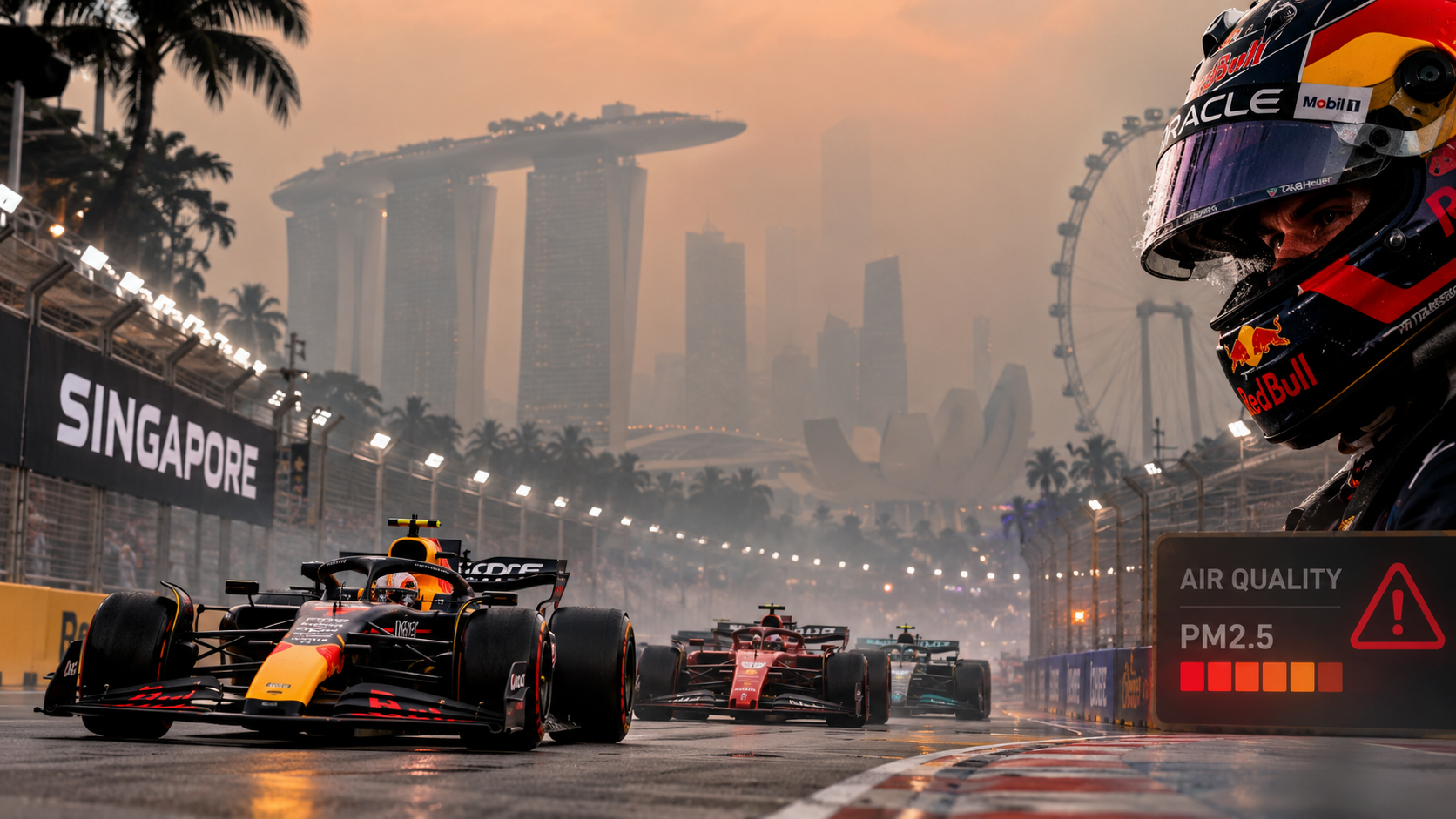
A thick haze caused by wildfires in Indonesia has blanketed Singapore in recent days, leading to deteriorating air quality across the city-state. With Formula One arriving at Marina Bay for this weekend’s night race, concerns have emerged about the potential impact of the polluted air on drivers, teams and spectators.
Singapore’s National Environment Agency classified air quality levels as “unhealthy” on Tuesday as smoke from large-scale fires in parts of Sumatra and Kalimantan drifted across the region. The worsening conditions have coincided with preparations for one of Formula One’s marquee events.
While organisers and governing bodies do not currently expect disruption to the race weekend, contingency measures have already been discussed should conditions deteriorate further.
Why Singapore Is Covered in Haze
Haze is not a new problem in Singapore.
The phenomenon has affected the region repeatedly during Indonesia’s dry season, with smoke from forest and peatland fires frequently spreading across Southeast Asia.
According to Wang Jingyu, an assistant professor at Singapore’s National Institute of Education at Nanyang Technological University, conditions have been significantly worsened by a “super” El Niño event. He stated that rainfall across the region has been around 80% below normal levels since June, helping create the most intense fire season in more than a decade.
Those dry conditions have allowed fires to spread across parts of Indonesia, creating thick smoke that has reduced visibility and degraded air quality in neighbouring countries.
For Singapore, the timing is particularly unfortunate given the global attention generated by the Formula One weekend.
The Singapore Grand Prix has built its reputation around the Marina Bay skyline, illuminated streets and spectacular night-race atmosphere. This year, however, much of that skyline has been obscured by haze.
FIA and Organisers Have Contingency Plans
At present, there is no indication that Formula One’s schedule will be affected.
An FIA spokesperson told The Guardian that contingency measures remain available if conditions worsen, although any restrictions would be more likely to affect entertainment or outdoor activities rather than the racing itself.
Race organisers have also confirmed preparations are in place.
According to statements reported by multiple outlets, organisers will provide N95 masks if required and work closely with Singapore authorities and relevant agencies if haze conditions create concerns relating to visibility, public health or operational safety.
Singapore Grand Prix organisers previously integrated haze-response measures into event planning, particularly after the 2019 race weekend when unhealthy air conditions also affected the city.
For now, the event remains on schedule.
Why Air Pollution Matters in Formula One
The biggest question is not whether the race can go ahead.
The bigger question is how prolonged exposure to polluted air could affect driver performance.
Singapore is already regarded as one of Formula One’s toughest races.
High humidity, extreme cockpit temperatures and a physically demanding street circuit combine to make the event one of the most challenging tests on the calendar. Drivers regularly lose significant amounts of body weight during the race because of heat and dehydration.
The addition of poor air quality introduces another layer of difficulty.
According to Chris Carlsten, a professor of medicine at the University of British Columbia who studies the effects of air pollution on the human body, exposure to elevated pollution levels can affect cognitive performance.
The concern is particularly relevant in Formula One, where races are often decided by fractions of a second and where reaction times can be the difference between avoiding or causing an accident.
GUZ Analysis
While there is no evidence suggesting drivers will be unable to compete, air quality concerns deserve attention because Formula One places extraordinary demands on concentration.
Drivers make thousands of decisions during a race while travelling at speeds exceeding 300 km/h. Any factor that affects alertness, concentration or physical recovery becomes relevant.
The challenge is magnified in Singapore because the race combines intense humidity, long race duration and limited opportunities for physical recovery during a lap.
Even marginal declines in cognitive sharpness could theoretically have a greater impact in Singapore than at less physically demanding circuits.
That remains analysis rather than a confirmed prediction.
Spectators Could Also Be Affected
The conversation is not only about drivers.
Thousands of spectators are expected to attend the Marina Bay event, many spending extended periods outdoors.
Singapore authorities monitor air quality using the Pollutant Standards Index (PSI), which categorises conditions ranging from moderate to hazardous. Previous haze episodes have prompted organisers to distribute N95 masks and provide public health guidance to attendees.
Should air quality worsen significantly during race week, organisers and government agencies could introduce additional measures to protect fans and staff.
At the moment, however, no such action has been announced.
Formula One Faces Another Unusual Weekend
The Formula One paddock arrives in Singapore following an eventful race week in Malaysia, but environmental conditions may become one of the talking points of the weekend before a wheel is turned at Marina Bay.
The key message from officials remains consistent.
There are contingency plans.
The race is expected to proceed as scheduled.
And organisers continue to monitor conditions closely.
Yet the images emerging from Singapore underline a broader issue extending far beyond sport.
The haze affecting this weekend’s Grand Prix is a visible reminder of the environmental challenges facing Southeast Asia during periods of extreme drought and wildfire activity.
For Formula One drivers, the challenge may simply be another obstacle to overcome.
For the region, it is a much larger problem.
About The Author