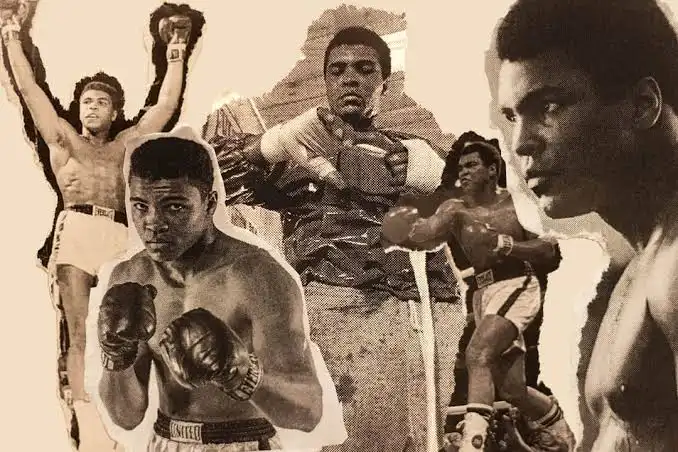
here are champions, and then there is Muhammad Ali — a fighter so transcendent that his name became a synonym for greatness itself. Decades after his final fight, “The Greatest” remains the standard every boxer is measured against, not just for what he did in the ring, but for what he represented outside it.
The Style That Broke the Mold
Before Ali, heavyweights were built like tanks and moved like them too — bruisers who traded power for power. Ali flipped the script entirely. He had the footwork of a welterweight and the hand speed to match, famously summarized in his own words: “float like a butterfly, sting like a bee.” At 6’3″ and built more like an athlete than a brawler, Ali dismantled opponents with movement and precision rather than brute force, making him almost impossible to hit clean in his prime.
The Fights That Defined Him
Ali’s résumé reads like a highlight reel of boxing’s greatest moments:
- Cassius Clay vs. Sonny Liston (1964) — A massive underdog, the 22-year-old shocked the world by dethroning the seemingly unbeatable Liston, announcing himself to the world with the words: “I shook up the world!”
- The Rumble in the Jungle (1974) — Facing the fearsome, undefeated George Foreman in Zaire, Ali unveiled the “rope-a-dope” strategy, absorbing punishment against the ropes before dropping Foreman in the eighth round in one of sport’s greatest upsets.
- The Thrilla in Manila (1975) — The brutal trilogy finale against Joe Frazier is still regarded by many as the greatest heavyweight fight ever contested, a war of attrition fought in extreme heat that pushed both men to their absolute limits.
More Than a Boxer
What separates Ali from every other fighter on this list is that his story doesn’t end at the ropes. He refused induction into the U.S. military during the Vietnam War on religious and moral grounds, a decision that cost him his title and three prime years of his career, but cemented him as a symbol of conviction far beyond sport. He returned to reclaim the heavyweight title not once, but twice — becoming the first three-time lineal heavyweight champion in history.
The Numbers
- Professional record: 56 wins, 5 losses (37 by knockout)
- World heavyweight champion: 3 times
- Olympic gold medalist: 1960, Rome (light heavyweight)
The Legacy
Ali fought his final bout in 1981, but his influence never left the sport. Every fighter who talks trash before a bout, who dances rather than plants their feet, who treats boxing as performance as much as combat, is working in a tradition Ali built from scratch. He didn’t just win fights — he changed what a boxer was allowed to be.
About The Author